

Why the Cross!
Isn't the Lord risen from the dead?

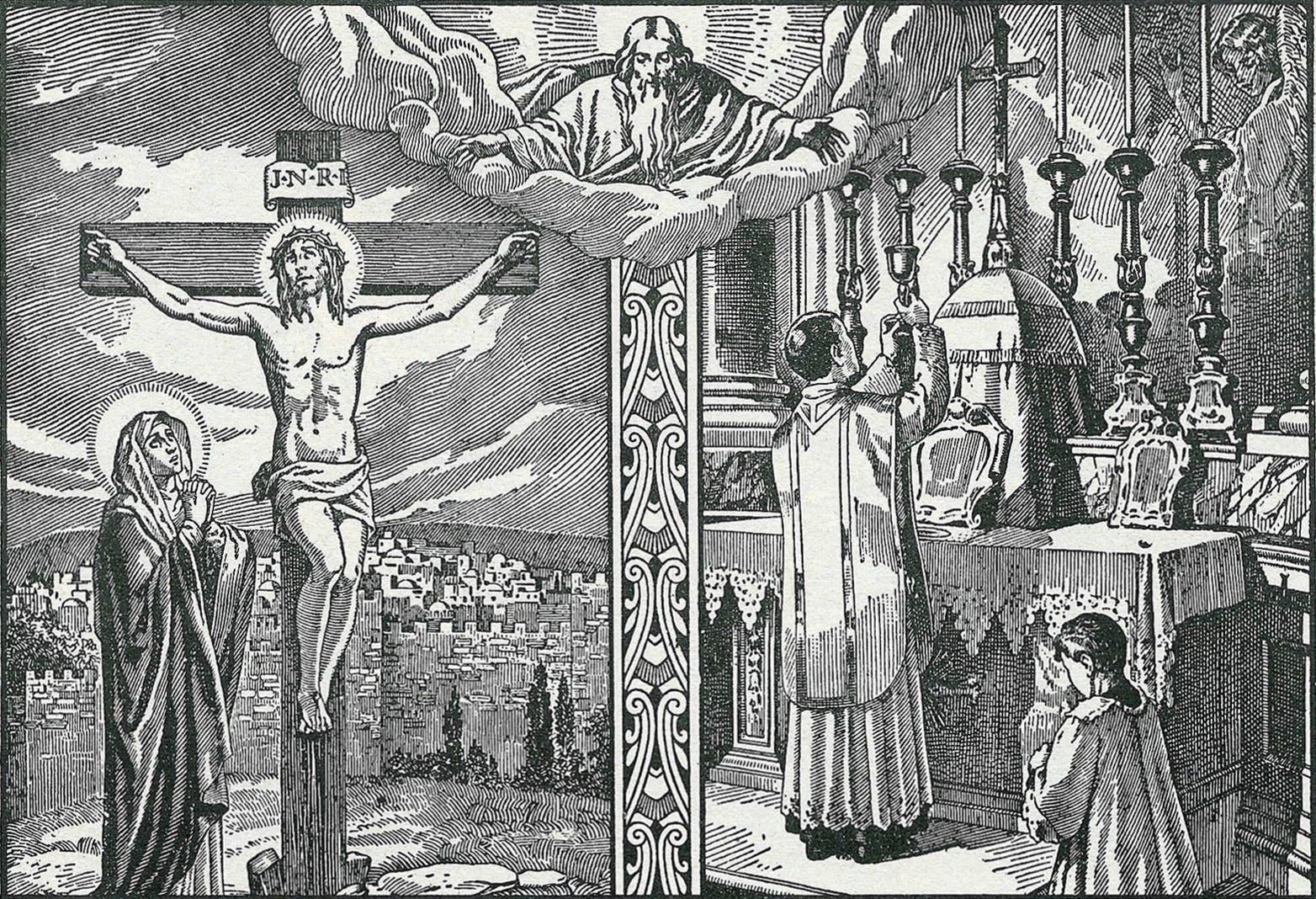
Christ is risen! Yes, is not the Lord risen from the dead? Why place Him on the cross? Why emphasize the middle of the story? The cross is not the end of the story!
Life is marked by its inevitable end. Throughout this life, we ponder death constantly. Each day lived and passed is one less day to enjoy the manifold blessings God has given us in this life. Indeed, even the Christian life is bound to end in death. We all fear it, but we cannot avoid it, despite our feeble attempts.
Even after Eastertide, death wreaks havoc. It does not rejoice with us in our 50-day commemoration of the Resurrection of our Lord. Neither does it rest during the time of the Church, as the season following the Feast of the Holy Trinity is often called. Death will not break for a seasonal hiatus while we revel in our Lord’s resurrection. Indeed, death will not rejoice with us, whether in Eastertide or in ordinary time, for it seeks to desecrate and destroy our joy. But we continue to rejoice.
Death need not rejoice with us. It has been triumphed. Our Lord has defeated it. This glorious victory of death emboldened the beloved Paul Gerhardt to write:
This is a sight that gladdens;
What peace it doth impart!
Now nothing ever saddens
The joy within my heart.
No gloom shall ever shake,
No foe shall ever take,
The hope which God’s own Son
In love for me hath won.
Our faith is bound up in the death and resurrection of our Lord. This informs everything that we do. We sing, we pray, and we worship. We live, we move, and we have our being in the continual reality that Christ has overcome death by death. He has overcome Satan and his hordes. He has triumphed over sin and the grave. None of this could happen without His death and resurrection. Everything we think, say, or do points to this salvific reality—our sure and certain hope in the atonement won for us.
Still, however, many Christians perennially distrust, disparage, and disavow these things which Lutherans often take for granted. Our liturgy, our images, our piety—many of the vestiges of our confessional heritage are oft subverted. The liturgy is unfashionable. The images are displeasing. The piety is overwhelming—disingenuous, perhaps. The very confessional heritage to which we belong—for which we ought to give abundant thanks to God—is “dead.”
Arguably worst of all, the crucifix is utterly and terrifyingly offensive.
Unfortunately, some Lutherans mimic these destructive tendencies. Other Christians fare well without liturgy, worship without “idolatrous” images, and exercise their free Christian piety in unfamiliar ways. Why can’t we? It is a fair question, and there may be situational latitude in how we approach these questions. Liturgies have matured and evolved throughout church history, the use and appearance of images have developed, and piety takes various contextual and theological forms.
We can quibble about these things. There is latitude. There will be distinction. Orthodox Lutheran agendas were perfectly content with this. While we cannot thrust aside our orthodox Lutheran roots—whether in liturgy, in images, or in piety—we can discuss reasonable distinction or expansion. Even where there is little wiggle room, there is still room.
What we cannot quibble about is the crucifix. The cross is non-negotiable.
The aversion to the cross has many roots. We poor sinners hate the cross because it reminds us of our sin. We wicked men despise the punishment for our own sin. We are uncomfortable with the atonement because a just, righteous, sinless Man died for the sins of the whole world. A genuine intention might be to cling to the hope of the resurrection—and that is incredible important.
Nevertheless, the sure and certain hope of our salvation, the completion of the atonement for mankind, and the moment of victory over sin, death, and the devil comes from the cross—and it is again brought before us in the resurrection.
The joy and triumph of Easter brings peace and comfort to the Christian conscience because Christ died and rose again. The resurrection first requires the crucifixion—and, as Paul writes to the Romans, brings about our justification (Rom. 4:25). Here lies an important theological distinction that is often glossed over: the atonement and justification are two separate realities. They are not competing realities, but they are separate nonetheless.
For the believer, the atonement and justification are bound up together in an eternally inextricable bond, which is realized by faith. For the unbeliever, however, the atonement and justification are bound up in another sense. The atonement applies to their sins, for Christ died for the sins of the whole world (1 John 2:2), but it is not brought to effect for their salvation, because they are not justified. In other words, believers receive the benefits of the atonement because they are justified, but unbelievers do not receive the benefits of the atonement because they are not justified.
Therefore, dear reader, our faith is bound up in the death and resurrection of our Lord. This informs everything that we do. We sing, we pray, we worship, we live, we move, we have our being in the continual reality that Christ has overcome death by death. He has overcome Satan and his minions. He has triumphed over sin and the grave. None of this could happen with His death and resurrection, and everything we think, say, or do points to this salvific reality—our sure and certain hope in the atonement won for us. Remember this well.
Thus, the crucifix reminds us of this sure and certain hope. It points to our salvation. It is the moment of the total, eternal, and triumphant defeat of sin, death, and the devil. It is the most triumphant, most victorious, most commemorative image to which we could cling—and we must.
For this reason, our liturgical celebrations would seem incomplete without the celebration of the Holy Sacrament. The shouts, Alleluia! Christ is risen!, by which we were especially inundated during Easter, would seem to be left untethered from the present reality of the resurrection without that tangible reality placed in our mouths—the risen Christ given unto death for you, who now makes His body and blood present here for you. An Easter Sunday without the Holy Sacrament would be uncharacteristic, impious, and liturgically improper, because the reality of our salvation which we celebrate on Easter Sunday is fulfilled at the cross.
So, too, Easter would be incomplete without the cross. In fact, the crucifix is the greatest image of our Easter triumph. We do not “keep Jesus on the cross” to undermine His triumph over sin, death, and the devil. We honor the image of our crucified Lord because it is the image of our salvation. We look to the very image that establishes all our hope and gladness and permeates our life as Christians—the moment of our salvation won for us.
Hence the great Resurrection hymn, Christ is Arisen, authored by Michael Weisse in 1531 and sung to this day by the faithful:
He who hung accursèd
And for comfort thirsted,
He liveth now in gloriousness,
Fore’er prepared to plead for us.
Alleluia!He who in all silence
Bid to hell defiance
And hath the well-armed strongman bound,
Is now on high with glory crowned.
Alleluia!He who there lay buried
Is to glory carried,
And His great deed on high is raised
And in all Christendom is praised.
Alleluia!Now He ends perdition,
Preaching sin’s remission,
Which through repentance true is gained,
And thus alone, as He ordained.
Alleluia!—Christus ist erstanden, sts. 3-6
Author: Michael Weisse, 1531
Translator: composite
I was quite disturbed to hear a mature Christian refer to this as "morbid Christianity" and go so far as to say the cross is not our victory, but only the resurrection. To him I would like to ask: what is the one thing in which the Apostle Paul boasted?
Thank you. That devotion was a needed reminder to us all!